


Researchers in Nanjing, China, have made sensible contact lenses that observe eyes utilizing radio tags, helpful in healthcare and augmented actuality.
Good contact lenses, a comparatively new know-how, monitor varied well being components and facilitate human-machine interplay (HMI) by monitoring eye actions by means of methods similar to pupil centre corneal reflection and electrooculography (EOG). Nevertheless, these strategies typically lack precision and are weak to interference. Furthermore, EOG, which entails utilizing pores and skin electrodes to collect knowledge, has doubtlessly been discovered to hurt the pores and skin.
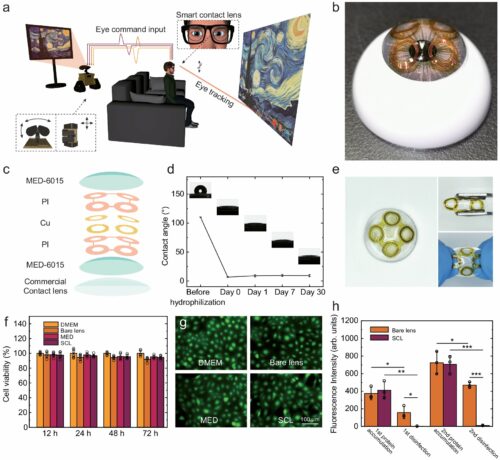
Scientists in Nanjing, China, have created eye-tracking sensible contact lenses with radio frequency tags appropriate to be used in healthcare and augmented actuality (AR) purposes. These lenses are biocompatible and invisible to the wearer, functioning with out batteries or conventional silicon chips.

Human-machine interplay
Human-machine interplay (HMI) is significant in know-how’s development throughout gaming, healthcare, AR, and robotics. Eye-tracking through sensible contact lenses improves HMI by monitoring well being, aiding robotic communication, and enhancing AR. But, challenges immediate the exploration of frequency-encoding for higher accuracy.
Frequency-encoding
Researchers have developed a sensible contact lens that makes use of radio frequency (RF) indicators encoded by embedded RFID chips to trace eye actions. These wi-fi, battery-free tags emit distinctive frequencies that change as the attention strikes, permitting a system to exactly monitor the course and extent of eye actions in actual time. This frequency encoding technique makes the sensible contact lenses compact, light-weight, and biocompatible, eliminating the necessity for standard silicon chips or batteries.
Making and testing the sensible contact lens
Researchers embedded 4 RF tags in a silicone elastomer to create biocompatible sensible contact lenses. A close-by transportable reader recorded indicators for human-machine interplay. The lenses detected gaze instructions and eye closures and had excessive angular accuracy for numerous purposes like gaming and searching. In vivo exams on rabbits confirmed security and performance, confirming that they resembled industrial lenses.
Potential purposes
The introduction of the Apple Imaginative and prescient Professional has sparked widespread curiosity amongst researchers and the general public, driving exploration into the potential purposes of eye-based computer-human interplay. This exploration guarantees to foster technological development and improve folks’s high quality of life by means of progressive options.
Reference: Hengtian Zhu et al, Frequency-encoded eye monitoring sensible contact lens for human–machine interplay, Nature Communications (2024). DOI: 10.1038/s41467-024-47851-y

