


The advertising and scientific communities are enthusiastic about radio entry community (RAN) slicing. RAN slicing is likely one of the vital new options of 5G networks; it makes differentiated companies attainable, enabling new options for purchasers and community monetization alternatives for operators. The third Technology Partnership Challenge (3GPP) specs outline the slice mechanism, however they don’t say something about the best way to implement the slices. Additionally, we haven’t seen many production-level, real-world implementations of RAN slicing, maybe as a result of 5G enterprise roll-out is advanced. Now we have carried out analysis and produced new outcomes associated to RAN slicing and I’d wish to enumerate a number of that can make it simpler for operators to make use of it with Microsoft Azure.

Azure for Operators
Modernize and monetize your community
Service assurance with RAN slicing
Latency-sensitive cellular functions—similar to Xbox Cloud Gaming, Microsoft Groups video conferencing, Microsoft Combined Actuality, distant telemedicine, and cloud robotics—require predictable community throughput and latency. The 3GPP specs acknowledged this requirement for next-generation cellular apps, and they also launched community slicing, a virtualization primitive that permits an operator to run a number of differentiated digital networks, known as slices, layered on high of a single bodily community. RAN slicing is of explicit curiosity for service assurance for the reason that last-mile wi-fi hyperlink is usually the bottleneck for cellular apps.
The Technical Downside
Ideally, a community operator ought to be capable to configure a community’s useful resource allocation coverage to cater to the particular connectivity necessities of every subscribing utility. However, within the real-world, typical base station schedulers optimize for coarse metrics, similar to the combination throughput on the base station or the combination throughput achieved by a bundle of functions. The issue is that neither of those strategies ensures satisfactory efficiency for every utility linked to the community.
A community slice can assist a set of customers or a set of functions with related connectivity necessities. Operators can distribute sources, like bodily useful resource blocks (PRBs), within the RAN amongst the slices to offer differentiated connectivity.
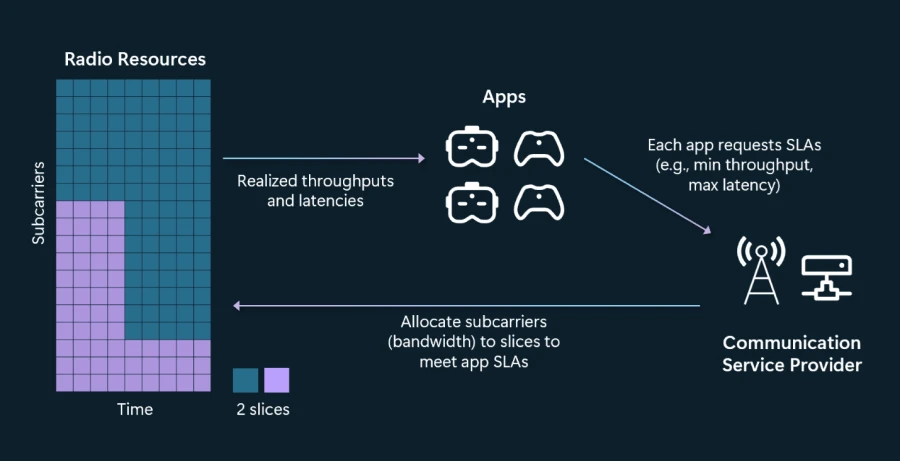
Current approaches allocate PRBs to totally different slices to ensure slice-level service assurance by means of service-level agreements (SLAs). Nevertheless, as I discussed earlier, to appreciate the envisioned advantages the place apps obtain the community efficiency they require, service assurance needs to be supplied on the utility stage. Current approaches fall wanting enabling operators to offer this vital functionality. Slice-level service assurance doesn’t assure throughput and latency to every app within the slice, since totally different customers in the identical slice can expertise wildly totally different channel situations. Additionally, apps be part of and depart the community asynchronously, which makes optimization onerous. We’d like app-level service assurance to fulfill the necessities of every app inside a slice. To perform this, we recognized and addressed the next two challenges:
- State-space complexity
Prior approaches present slice-level service assurance by monitoring a state area consisting of mixture slice-level statistics, together with the typical channel high quality of all customers in a slice and the noticed slice throughput. To increase these strategies to assist app-level necessities, one might deal with every app as a slice. The issue is that doing so expands the state area to incorporate the channel high quality, the noticed throughput, and the noticed latency skilled by every app. The ensuing state area, consisting of all attainable values that the tracked variables can take, grows shortly, and looking by means of this state area to find out an allocation of PRBs that complies with the apps SLA ends in an intractable optimization drawback for sensible deployments the place the community should accommodate tons of of apps. - Figuring out useful resource availability
To compute bandwidth allocation for slices, operators sometimes run admission controllers that admit or reject incoming apps in keeping with some coverage. The coverage could rely on slice monetization preferences, equity constraints, or different targets. Algorithms for admission management have been studied extensively. Basically, operators want a method to decide if the RAN has sources to accommodate the SLAs of an incoming app with out negatively impacting the SLAs of apps already admitted. Sadly, prior approaches are troublesome to adapt as a result of they compute required PRBs to assist slice-level SLAs. As soon as once more, the state-space complexity precludes treating every app as a slice.
Discover the RAN-slicing system from Microsoft
Now we have designed and developed a radio useful resource scheduler that fulfills throughput and latency SLAs for particular person apps working over a mobile community. Our system bundles apps with related SLA requests into community slices. It takes benefit of classical schedulers that maximize base station throughput by computing useful resource schedules for every slice in a means that satisfies every app’s necessities. Below this mannequin, apps specific their community necessities to the operator within the type of minimal throughput and most latency. Engaged on behalf of the operator, our system then fulfills these SLAs over the shared wi-fi medium by computing and allocating the PRBs required by every slice.
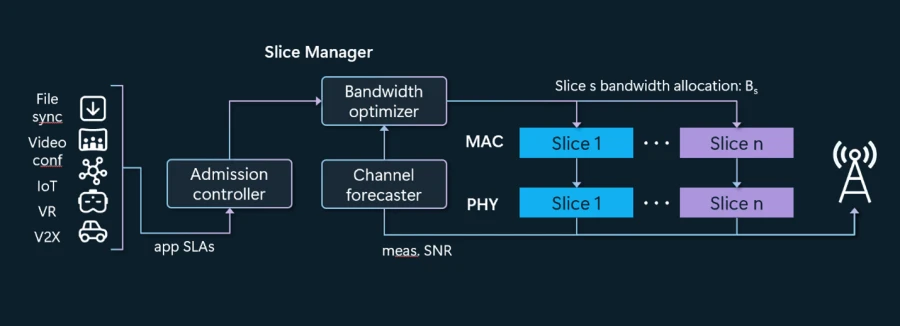
Our system addresses the challenges in enabling app-level service assurance in a wi-fi setting by making use of the next methods:
- We handle the search-space complexity, and we decouple the community mannequin and the management coverage. We do that by formulating SLA-compliant bandwidth allocation as a mannequin predictive management (MPC) drawback. MPC is nice at fixing sequential decision-making issues over a transferring look-ahead horizon. It decouples a controller, which solves a classical optimization drawback, from a predictor, which explicitly fashions uncertainty within the setting.
- We use standalone predictors to forecast every of the state-space variables, such because the wi-fi channel skilled by every app. Our system then feeds these predictions right into a management algorithm that computes a sequence of future bandwidths for every slice based mostly on the anticipated state.
- We scale back complexity by letting our management algorithm effectively prune the search area of attainable bandwidth allocations as a result of we word that app throughput and latency range monotonically with the variety of PRBs.
- We forecast RAN useful resource availability by designing a household of deep neural networks to foretell the distribution of required PRBs. We prepare these neural networks on simulations of our management algorithm offline after which apply them to foretell the useful resource availability in actual time.
At a high-level, we base bandwidth (PRB) allocation on predicted channel situations. When the sign to noise ratio (SNR) is excessive, we consider packet loss shall be decrease, and the PRB allocation matches what the app requested for. When SNR is low, packet loss shall be larger, so to compensate, PRB allocation is larger. To assist the admission controller, our system exposes a primitive that estimates if there’s bandwidth out there to accommodate an incoming app’s necessities. The great factor about that is that the admission management insurance policies are unbiased of the bandwidth availability, permitting the operator to independently implement their monetization insurance policies.
Our O-RAN-compatible system realizes the above concepts. Now we have applied our RAN slicing system in our production-class, end-to-end 5G platform. We applied hooks throughout totally different modules in vRAN distributed unit to regulate slice bandwidth dynamically with out compromising real-time efficiency.
The operator can configure its RAN with a set of slices, catering to totally different visitors sorts and enterprise insurance policies, for instance, separate slices for Microsoft Groups and Xbox Cloud Gaming classes. Relative to a slice-level service assurance scheduler, we considerably scale back SLA violations, measured as a ratio of the violation of the app’s request. Our system allows operators to unravel the vital problem of offering predictable community efficiency to apps. On this means, app-level service assurance will be constructed right into a production-class vRAN.
Uncover options that empower builders
Microsoft is pushing onerous on making programmable networks actual. We consider this can be a crucial, basic functionality for builders to write down functions and construct companies which are considerably higher than the present day functions. Community RAN slicing is a crucial step on this journey. With RAN slicing, we are able to assist safe and time essential functions, which require sustained predictable bandwidth. This in flip will result in operators with the ability to present many new and enticing community service options with operational effectivity for next-gen utility builders.
RAN slicing is a wonderful concept, and we’re making it actual. We hope numerous RAN distributors will incorporate these concepts as they combine with Microsoft Azure Operator Nexus. Deeper technical particulars of what I wrote about are supplied in a paper we revealed lately, “Utility-Stage Service Assurance with 5G RAN Slicing.”

